Un laberinto propio
Reading as a conversation with life
November 2026 · El Ojo del Tiempo no. 177 · 400 pages
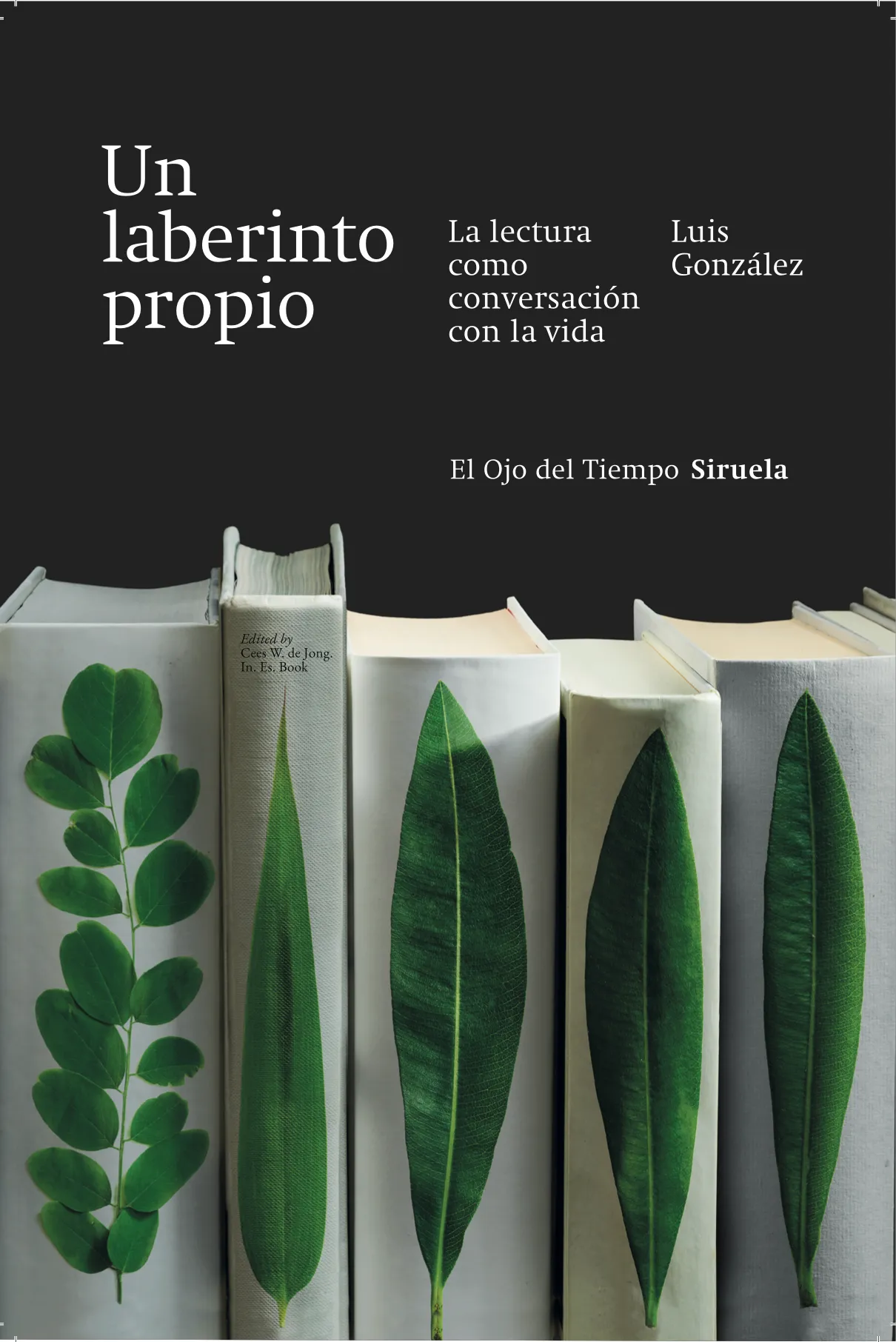
A conversation with life
Un laberinto propio (“A Labyrinth of One’s Own”) is an invitation to rediscover reading as an experience with the power to transform the way we think, feel and live. It is a literary essay that blends evocation, practical knowledge and personal narrative to share some keys to the positive role of reading in our lives.
The author charts a journey through the books, music, cities and landscapes that have shaped a way of understanding the world, in the company of Virginia Woolf, Dickens, Vargas Llosa, Beethoven, Asimov, Dante, Jane Austen, Wagner, Lawrence Durrell, Borges, Elizabeth Jane Howard, Tintin, María Zambrano, Schubert, Star Trek and Miyazaki, among many other stimuli.
The itinerary is written in a warm, approachable tone and shares a conviction: reading is a fundamental human technology — it combines effort and pleasure, trains creativity, and strengthens analytical thinking and health. Each chapter traces unexpected connections that invite the reader to get to know certain books, to enjoy very special experiences in places both emblematic and unknown, to uncover some secret keys to the impact of reading, or to witness episodes involving leading figures from the world of books and literature.
This book does not argue a closed thesis; it offers a score for each person to perform their own version. The labyrinth acts as the structural metaphor for an immersive experience that advances through digressions and associations between ideas and episodes, following unconventional links, in conversation with life. Every reader who enters this labyrinth will trace a path of their own.
Edition details
- Title
- Un laberinto propio. La lectura como conversación con la vida
- Author
- Luis González
- Cover design
- Manuel Estrada
- Cover photograph
- Javier Ayuso
- Publisher
- Ediciones Siruela
- Series
- El Ojo del Tiempo, no. 177
- Publication
- November 2026
- Pages
- 400, paperback with flaps
- ISBN
- 979-13-88032-71-4
- Price
- €23.95
- Thema classification
- DNL
Contents
- The power of reading, the power of digressionsReading to understand the future – Jaspers and the axial moments of history – We are citizens of the Roman Empire – Reading as divination – From Isaac Asimov’s Foundation cycle to strategic planning – How listening reverently to Cavafy may have saved lives
- Ambitious reading and the labyrinthA summer in England to learn Italian – The power of a good teacher to change your life, or to make you see that you are like Dante – The Ljubljana Manifesto – The pleasure of walking through a wooded labyrinth – The euphoria of reading the Venetian labyrinth despite Hitchcock’s birds
- Reading as a human technology for innovationReading to save calories, and as a key to civilisation – Reading as a human technology, following Ong’s ideas – Jorge Semprún’s question and the arguments of Plato’s Phaedrus against books – Karl Popper and the fall from the horse – Reading is also the key to innovation
- Effort, pleasure and healthReading as an effort for the brain – Pleasure after effort: the bicycle, music, or reading to the point of obsession with mastering something – The will to enjoy Wagner – How our context changes the reading we make of music or of a book
- Reading as artistic creationBernstein’s unique reading of Nimrod, Inés’s music – An exaggerated Anglophilia brought on by books – The Alexandria Quartet as the epitome of reading’s power to understand others – Happiness in the London labyrinth – Elizabeth Jane Howard
- Reading and analytical thinking: BrexitA conversation with Miha Kovač on higher-level reading – The tragedy of Brexit versus the capacity for analytical thinking that ambitious reading provides – Weaving reading into real experience – Woods and valleys with Beatrix Potter – A walker’s guide to London’s neighbourhoods in the company of literature – At the Chelsea Arts Club with Richard Charkin OBE
- Reading and libraries as assets of European societyBooks and music read to Inés – Lost in the analogue labyrinth of the Côte Sauvage – Deep in a labyrinth in Macfarlane’s company – Cycling among vineyards like a book full of lines – A long walk along the Charente as a different kind of reading – Libraries, the Romanesque and Europeanism
- Linear reading as the key to the knowledge societyThe technology of glass and of books – The first national reading promotion plan – The linear, immersive, deep reading of a text, and pilgrimages – The Winterreise in Bostridge’s company – Reading as the electric journey of words through the brain
- School is decisive for reading, and for everything elseSwifts and the complexity of freedom – The Readmagine of the pandemic’s digital acceleration – The PARIX school – A researcher unravels, with three clues, the keys to the arrival of printing in Spain – Sitting beside Cortázar, and standing motionless next to Borges in a Joy Division T-shirt – The importance of good teachers
- The three keys to the printing press in SegoviaIn the labyrinth of a bourgeois Castilian city – The degree of economic complexity as a factor of development – The open society as a stimulus for development
- The fourth, Roman key. Reading and the creation of wealthThe Rome that lives on in the Castilian highlands and in Charente-Maritime – The links between Rome and Segovia around books – A Weberian key to correlating reading and the creation of wealth – Another digression on labyrinths – The Startup of the Book – The platform oligopoly and reading
- The many kinds of reading, and the digital as opportunity and threatWhat do we call reading? – The importance of marketing on behalf of reading – Wattpad as an example of a digital opportunity – And… have I turned into a Luddite at this stage? – Naomi Baron and the importance of the analogue
- Four ways of walking through Rome, and childhood readingsThe joy of spending time with Italian readers and publishers – The four ways of reading Rome – Reading an Englishman who describes the wooded labyrinth of my childhood – The labyrinth of the library in my grandparents’ house
- The nightmare of too many booksA house move turned nightmare – A journey along the fabric of books on the wall – An interview at Havana airport and tears by the roadside – Calvino’s epiphany – A Galdosian reunion in the Plaza del Segundo Cabo – Book design through the eyes of Manuel Estrada
- Reading is a weapon for freedom and equalityMadrid fills with colour – Changes of home and the stages of the city’s evolution – The delights of working in the world of books – An Ibero-American capital – Free and equal
- Reading as conversation, and human creativityThe World of Yesterday – A recapitulation of all the above to glimpse the future – The home library as our toolbox for creative divergence – A final jolt when I thought I had finished this book – The transcendental in a musical score
- Annex: A labyrinth of readings
Preface
What is this book?
A first way of answering this question would be to tell you that it is a combination of the following elements:
- An organised sequence — even if at times it may not look like one — of ideas about how reading affects our lives for the better.
- Suggestions of books that might interest you, and invitations to explore music, places and experiences.
- And a personal itinerary in the form of a labyrinth, in which the autobiographical is interwoven with books, cities, music, authors and memories.
And yet I have the feeling that these three points simplify the description of this book to such a degree that they could be misleading. So let me put it another way, with more nuance, in the paragraphs that follow.
This book could be defined as a light essay on reading, accompanied by biographical episodes, anecdotes from the world of books and literature, and conversations with some of the most important thinkers on the benefits of reading, as well as scholars of the publishing sector. All of this is interwoven with somewhat more literary passages and with connections between reading and certain moments of my life — or of other people’s — that help to illuminate the book’s thesis.
My aim is that in these pages you will find arguments, and the odd suggestive piece of evidence, to persuade you — among other things — that reading is the most powerful tool ever created by Homo sapiens; that it is a human technology combining effort and pleasure; that it is an activity that can lengthen life and improve its quality; that when you read a text you become an artist, because you build in your brain a unique interpretation of that book; that ambitious reading strengthens analytical thinking and, with it, democratic coexistence; that the digital world is a consequence of reading and can become an opportunity or a threat, depending on how intelligent the strategies we deploy turn out to be; and that reading is also a conversation, a way of linking ideas — and that this web of connections is the fundamental key to human creativity.
I have already said that this is a light essay, and it is worth insisting: it is not an academic or scientific work. It is more literary than technical, more ironic than rigorous and — or so I hope — more entertaining than systematic. There may be the odd denser passage, but I believe these amount to brief stretches of the book.
If this text asks anything of you, it is that you play — that you accept the invitation so that we can play together. That you enter this labyrinth with a curiosity like the one you would bring to wandering a new city, and that you make it a labyrinth of your own. That you read these digressions as one lets oneself be led down a forest path that suddenly opens onto a discovery. In short: that when the journey is over, your own connections should be worth more than mine.
So the first thing these pages offer you is a set of arguments to persuade you that reading changes our lives, and sometimes makes us who we are.
Secondly, they invite you to explore very different books: poems, novels, essays, treatises that may manage to stir your curiosity.
Thirdly, I wanted to hand you a score: a map of ideas, experiences and books that only acquires a unique meaning when you perform it. Imagine it as a symphony that advances with its own changes of tempo: from a ridiculous anecdote to an unexpected revelation about a new dimension of reading; from walks through Venice, London or Rome to the books that teach us to decipher that same labyrinth; from the curious relationship between the invention of bottle-making machines and the act of reading, or the echo of a piece of music that suggests an itinerary; or from the way family shapes our relationship with reading at the root, to the evidence that a good teacher — or a commitment to a strong education system — can offset the inequalities that arise from childhood onwards. This journey may look more like a fluke than a plan, but it was really conceived as a billiards strategy.
One play, for instance, may begin with a first ball set rolling by an almost innocent gesture: the memory of a teenage infatuation with an Italian girl during a holiday in England. That ball runs on and grazes another — the one in which that boy suddenly identifies with Dante Alighieri when, back home, a teacher presented a sonnet from the Vita nuova in class. That ball in turn drives a third: the Ljubljana Manifesto in defence of ambitious reading, and the conversation with its author about the first books we read in our lives. The movement continues and touches one ball more — the one about how what is read to you in childhood shapes the way you perceive places, and about neural plasticity. That ball, in its turn, nudges another, linking that malleability to wanderings through a wooded labyrinth and the readings that go with them. And, in a final stroke of luck or clumsiness, the whole chain ends by pocketing one last ball, devoted to getting lost in a Venetian labyrinth.
Fourthly, I have drawn on the twenty-five years I have spent working in the world of reading to weave in a good number of autobiographical notes — personal anecdotes from childhood and adulthood, ridiculous situations and other curious episodes. The book opens, in fact, with a few passages rescued from a notebook of personal diary entries.
So let us begin with that: with the morning Inés came down to breakfast with her parents…
Publishing information
Publication scheduled for November 2026 in the El Ojo del Tiempo series from Ediciones Siruela.
ISBN 979-13-88032-71-4
Ediciones Siruela